I’ve been walking Tucson roofs for years, and I can tell you the easiest money a homeowner leaves on the table is the solar system they already paid for and then forgot about.
Last summer I was up on a house in the Foothills to quote a coating job. The owner had panels installed about four years back and had never touched them. I ran my hand across one and it came back gray. Not dusty. Gray.
That’s caliche dust baked on by the sun and set in place by a few monsoon seasons of rain and grit. He’d been paying an electric bill he thought was just the cost of a hot Tucson summer, and part of it was sitting right there on his roof.
If you own solar panels in Arizona, keeping them clean is basic maintenance, the same way you’d change the filter on your AC.
Arizona dust is not like everyone else’s dust
Solar companies love to tell folks that rain takes care of the panels. That may hold up in Seattle, but not so much in the Sonoran Desert.
Tucson gives your panels a very specific kind of buildup: We’ve got fine caliche and construction dust that travels for miles on the wind. We’ve got palo verde and mesquite pollen every spring that turns everything yellow. We’ve got bird droppings, which are worse than dust because they block light completely instead of just dimming it. And we’ve got monsoon storms that kick a wall of dirt into the air, dump a little rain on it, and leave a mud film behind when the sun bakes it dry.
Most people assume a good monsoon downpour is a free wash—but the reality is, around here, a storm usually leaves panels dirtier than it found them.
You already paid for the power
The solar industry calls dust buildup “soiling,” and it’s a real, measured loss. An NREL engineer put annual soiling losses at as much as 7% in parts of the United States, with much higher numbers in the world’s dustiest regions. Tucson sits on the dusty end of that range, and heavy buildup on individual panels can run well past that.
Think about what that means on a bill. If your system offsets a few hundred dollars a month in summer, giving up even a slice of that production year after year adds up to real money. And it’s money you already spent. You bought the panels, you paid for the install, you financed it or you wrote the check. Letting dirt eat the output is like buying a truck and never putting air in the tires.
Dirty panels also run hotter
Here’s the part most homeowners haven’t heard. When something blocks light on part of a panel, whether that’s a bird dropping, a leaf, or a thick patch of caked dust, that shaded section stops producing and starts absorbing. It heats up. In the trade that’s called a hot spot, and over enough summers it can damage cells and shorten the life of the panel.
In a climate where roof surface temperatures push past 150 degrees on a July afternoon, you don’t want to hand your panels any extra heat they didn’t ask for.
Cleaning is also a roof inspection
This is where being a roofing company matters, and I’ll be honest that it’s the part I care most about.
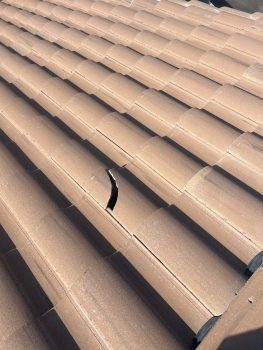
When my crew is up there cleaning panels, we’re looking at the whole roof. We see the cracked tiles under the array where an installer stepped wrong. We see the mounting penetrations and whether the sealant has dried out and split. We see lifted flashing, ponding on a flat section, and coating that’s chalking and needs attention before the next monsoon. Solar mounts put holes in your roof. Those holes need to stay sealed, and almost nobody checks them.
A cleaning company sees glass. We see the roof, and we photograph everything so you can look at it yourself instead of taking my word for it.
Why we don’t just hose them off
Tucson water is hard. If you spray your panels with a garden hose on a 100 degree afternoon, the water evaporates before it can run off and leaves a mineral film that’s worse than the dust you started with. Soap is no better. It leaves a residue that grabs the next round of dust and holds onto it.
We use reverse osmosis and deionized purified water. All the minerals are stripped out, so it dries spot free with nothing left behind. Combined with soft brushes, it lifts the buildup without scratching the glass or the anti-reflective coating, and it doesn’t void anything in your panel warranty.
Please don’t do this yourself
Don’t try to clean your panels on your own. I’m not saying this to sell you a service. I’m saying it because I’ve seen how these jobs end.
Tucson roofs are hot, they’re steep more often than people think, and tile roofs in particular are unforgiving. Step in the wrong spot on a tile and it cracks under you, and now you’ve got a leak path. Add a wet surface and a ladder, and you’ve got the setup for a fall that will cost a whole lot more than a cleaning.
There’s one more thing to keep in mind: Spraying cold water on panels that have been cooking all afternoon can shock the glass. If you’re going to clean your own, do it at sunrise, and understand you’re taking on the roof risk yourself.
How often you should do it
For most Tucson homes, twice a year does the job. Once in late spring before monsoon season, and once in early fall after the storms have finished throwing dirt around. If you’re near open desert, an active construction site, a dirt road, or you have a lot of trees and birds over the array, three times a year is more realistic.
The bottom line
Solar panel cleaning in Tucson is one of the few maintenance items that pays for itself in production you get back, and it gives you a set of eyes on a roof that has holes drilled through it.
We’re a veteran owned company, we’ve been doing this work in Tucson for a long time, and the inspection is free. If you want to know what shape your panels and your roof are actually in, give us a call and we’ll get up there and show you photos of exactly what we find. Just an honest look.